• Skip to main content
  • Skip to primary sidebar

Jenmenke

Road Warrior

  • Road Warriors
  • Garden
  • Food
  • Babble
  • Home

Archives for October 2009

Apple Madness, Part One. Ugly-But-Useable-Apples Recipes.

October 21, 2009

Ugly But Useable Apples

Ugh.

Ugh.

I wish I could be more upbeat about this whole harvest thing, but MAN. I’m ridiculously SICK of it. How do orchard people stay happy? How does anyone stay happy? It’s just one thing after another thing after another… it’s never over. I’m never done!

aah. I digress. Again.

Not only do I sit and think “Oh my gosh, I’ve got to deal with those _______.” (fill in the blank with apples, peppers, eggplant, kale plants, beets, carrots, parsnips, etc.) But then I think “Oh my gosh, I’ve got to get that apple post up on the blog.” And then I wonder “What the hell am I even doing this stupid blog for?” For which I do not have an answer.

Aside from my petulance about all the harvest things I have yet to do, I am really, really excited smug about this pairing of apple recipes.

First, know this: I grow organic apples.

Second, know this: I grow organic apples because it is the easiest way to grow apples. You basically do nothing, versus spraying chemicals on the apples every two weeks. I can’t be counted on to do anything “every two weeks.”

Third, know this: my organic apples are very ugly and hard to give away.

Fourth, know this: I hate to waste garden food and therefore I have a lot of ugly apples. Very tasty, ugly apples. Hence this combo of recipes.

Backstory
We had two hard freezes before September was over. Normally we have a few frosts, things wind down slowly and the apples are about the last garden item to be harvested, along with carrots and parsnips. This year however, our first frost was not a frost, but a freeze. The apples were mostly OK that night (26), but a week later the temps dipped down to 20. Not 25, but 20! So I spent the day picking all the apples and sorting them into 3 piles: compost, really ugly but useable, and maybe-I-can-eat-this-apple-fresh piles.

I use the “Really Ugly but Useable” apples for pies and sauce. I basically just cut away everything gross and use what I can. Last year, I was making tons of pies to freeze. I had a bucket of peels and cores under the sink in the compost bucket. I think I might have even emptied some coffee ground on top of them. Then I read something about boiling the peels and cores to get juice that you use for apple jelly. Honestly! That’s like making food from garbage!

So I brushed the coffee grounds off the browned peels and cores and dumped them in a pan with some water and started boiling. I got only 1 pint of jelly out of it, but oh MAN, it was so insanely good! In my opinion, it’s way better than my raspberry jam that everyone seems to want. The jelly was too runny last year, but I didn’t care. This year, I was hoping I could do it better.

So here is my process. And if I may be allowed to say so, it’s brilliant. I don’t know how many other people have ugly apples, but if you do, please don’t throw them away: try this!

Apple Sauce and Apple Jelly

The ugliest useable apples go into the Sauce/Jelly pile (this is a very complicated pile system) while the prettier ones go into the Pie/Jelly pile (that’s Apples Part Two, coming soon). Just for the record, my apples are a mixture of Honey Crisp, Haralson and two mystery varieties.

I take an apple, and cut it in half, then quarters, and assess the situation:

Would your child eat this apple?

if looks OK, I cut the core out and put that in the jelly pot. The quarters go into the Sauce Pot.

1) Learn to Focus your camera. 2) Put this apple in the Sauce Pot cuz it's fine.

If it looks über yucky, I use what I can.

Yucky Apple: Just cut off the bad parts and assess

Nice bright pieces go into the Sauce Pot.

Sauce Pot Apples

Mottled brownish pieces (trails from the Apple Magot Fly) go into the Jelly Pot.

Jelly Pot Apples

I do confess that we often just eat the less disgusting brownish ones. They are only trails of worms long gone. You can hardly see some of them. Just so you know: I like to think I’m preparing my family for some apocalypse that will take place some time in the future. My kids are going to be way more immune to gross food than yours will be.

Brown Apple Maggot Fly Tunnels. Go ahead. Eat it. It's Fine!

I work my way thru the pile (which isn’t disappearing nearly fast enough). And yes, that’s a trash can and yes, it’s kind of dirty…

Are you KIDDING ME? I still have all these Ugly But Useable Sauce Apples?!

The pectin for the jelly comes from the peels and the seeds, so you need those for the jelly. The peels stay on the sauce apples because I will put those thru the food mill and they make the sauce pink, which is very pretty. I could leave the cores on the sauce apples as well, but they are helpful for the jelly and it’s easy enough to just cut those out. Is this as confusing as I think it is? It shouldn’t be…

Oh my gosh I have a terrible headache… But I still have 42% battery left on my laptop, so I must press on!

I basically just keep going until one or the other pots fill up. Then I add about 1 cup of water to the sauce apples and turn on low and cover. I almost cover the Jelly Apples with water and add a whole bunch of ROSEMARY (my favorite flavor). Do not skip this step. If you don’t have any, go buy some. Seriously.

Rosemary! My Favorite! A MUST for Apple Jelly!

Add 1/2 cup of fresh squeezed (not!) lemon juice. (I’ll squeeze up to 1/4 cup. More than that, and I use this stuff, kindly given to me by my friend Chris when I complained that real lemon juice — as opposed to RealLemon brand yucko — didn’t exist. She got this at CostCo.

This upscale, organic Lemon Juice still tastes not fresh. Oh Well.

Stir it up and turn on low, cover and cook till apples are soft, at least an hour.

Just cover jelly apples with water and add rosemary.

Once soft and tender, line a strainer with several layers of cheese cloth (or use a jelly bag, whatever the Hell that is, if you happen to have one. I do not.) set over a large bowl and pour in. Do NOT push or force apples thru.

Jelly apples strain thru cheese cloth for several hours

This mixture needs to sit a good long time, preferably overnight in a cool place. I’m thinking that maybe it’ll be cool enough on my porch tonight. Ya think?

Meanwhile enjoy the October 3rd snow...

Meanwhile, the Sauce Apples should be soft and ready to process. Put the Sauce apples thru a food mill to get rid of the peels and any seeds.

Sauce apples go thru a food mill.

I put the food mill right back over the pot they cooked in because once you are done processing them, turn the heat back up, add 1/4 c lemon juice for about 4 lbs of cut apples and sugar to taste. I added about 1/2 cup. I also add about 1 teaspoon of cinnamon because we like that. Bring to a simmer and ladle into clean, hot sterilized canning jars.

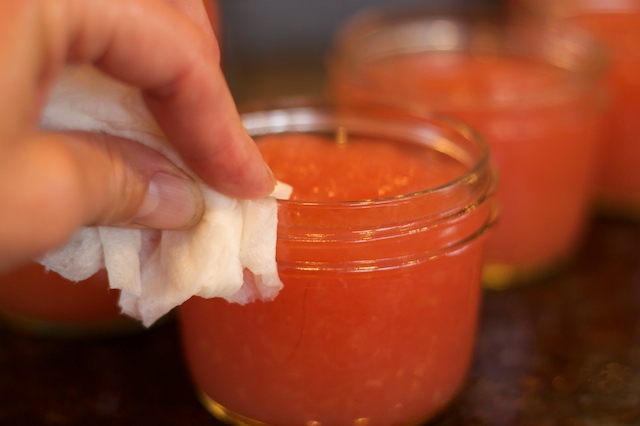
Once again, learn to focus camera as you fill sauce jars.Be sure to wipe jar rims or they won't seal!

Heat process (steam or boil) 10 minutes for 1/2 pint jars.

10 minutes for 1/2 pints.

You are now done for the day, go to bed feeling like a superstar. Tomorrow, though, it all begins again, so sleep well.

In the morning (or several hours later), put the juice from the strained apple rosemary mash into a measuring cup.

Beautiful Apple juice really for jelly making! (the next day)

I have just over 4 cups, so that means I need to add 4 cups of sugar. Put it into a big-ass pot, because the jelly needs to be cooked at a full rolling, foamy boil.

Rolling Boil to 220 degrees F

It took me about 20 minutes to reach the magic temperature of 220 degrees F. Be sure to skim off as much of the foam as possible because it makes a bigger difference for clear jellies. I don’t worry about it too much with my jam, but you can see it below, suspended in my jelly. As soon as it reaches 220, turn off the heat and ladle into hot, sterilized 1/2 pint jars, wipe the rims and seal. Heat process for 10 minutes. Refrigerate any jars that don’t seal.

Apple Rosemary Jelly (with bits of foam suspended in jar, dammit!)

See the foam? Really ticked me off, I have to say. But then, just another reason to keep it for myself.

I am just too damn good.

Apple Sauce and Apple Jelly. Leave it on your counter to admire for a couple days, then trudge it out to the garage or basement or where ever you store that type of thing.

No wait. This is just too damn good!

And this year, It’s the PERFECT consistency! So happy.

Filed Under: Garden, Food Tagged With: ugly apples, hard frost, harvesting, recipe, Rosemary, no pectin, Honey Crisp, Apples, Haralson, organic apples, apple jelly, apple sauce, apple maggot fly, wormy apples

Bulletproof Baguettes

October 12, 2009

Country Baguettes

You can shoot me if you don’t agree this is the easiest and best bread recipe you’ve ever tried. If, indeed, you have ever tried any.

I have planned to so this post forEVER. Well, at least since last April — which seems like forever. I did the Ciabatta Recipe, and the Crackerbread Recipe…

Oh my gosh! I just realized that I never actually did a blog post for the crackerbread. It only exists on youtube! How funny.

Anyway, I started this whole bread thing as videos, and then quickly realized that videos are a pain in the ass! Editing takes forever, upload takes forever. When I realize I forgot to film something, or I run out of batteries (always) it’s such a pain to reshoot it, re-edit it… you get the picture. So, for most everything else, I’ve moved to still-picture storytelling. For bread though, I think it’s worth it to show video. And that’s why it took me so long to do. The video still isn’t perfect, but I’ve come to the conclusion that it never will be. Not while I’m living this life. So please try not to be too critical of the fact that I never actually show the bread going into and coming out of the oven, there are three finished loaves instead of four, Etc. Etc.

This is the very first successful bread I ever made. I bought The Best Bread Ever, by Charles Van Over when I got my new Cuisinart food processor about 6 years ago. I had tried and tried to make rustic loaves prior to the discovery of this book and I have to tell you: it was an utter failure. No matter how I tried (and I tried, and tried, and tried), my loaves were pathetic, dense, ugly beasts. Oh sure, they tasted OK, but I tend to think of myself as invincible. Please note that I am not a perfectionist. That’s something else entirely. No. What I mean to say is that I have an inflated ego. So when I come up against something that I fail at, it makes me really, really mad. I can’t say I totally gave up on making bread, but I shelved it for a while.

Until I bought the Cuisinart.

When I opened the box, it came with the standard instruction manual with some recipes in it. (I confess: I am a manual reader.) When I was reading it, I saw this totally bizarre bread recipe. Having made countless loaves the traditional way — proof the yeast in warm/tepid/not hot/not cold/not below 110/not above 120/GiveMeABreak water — I thought the Cuisinart recipe must be a mistake. It listed the recipe source as having come from, The Best Bread Ever. So, I googled it to see what I could find out. Turns out, the book was out of print, but I found a used copy. This guy has researched the food processor technique ad nauseam. He has so much information and such detailed directions, it would make your head spin. And no, the recipe was not in error. Genius: you don’t have to proof the yeast!

But what I love about it: the recipes work every single time. Even when I forget about the dough and it bursts out of it’s container. Even when I put it in the refrigerator for 2 days. Every single time. It is so fast and easy. Seriously. You’ve got to try it. Hands on, it takes about 15 minutes to make dough and shape loaves, a couple hours of rise time and 10-15 minutes to bake. I very rarely have to even look at it anymore. But I still covet it. Thank you, Charles Van Over. You made a bread-maker out of me.

So get off the damn computer and go try it.

Watch the video:

And, here’s the recipe with written instructions to print:

Country Baguettes: The Best Bread Ever

Filed Under: Food Tagged With: food processor, bread baking, bake bread, easy bread recipe, baguette, rustic, The Best Bread Ever, Charles Van Over, no knead bread

Rosemary: Out of One, There Were Many

October 6, 2009

What a stupid title. Some days, I just don’t have it.

I’m chronicling my fall garden tasks and since rosemary is one of my top two flavors (the other being garlic), I always take care of my rosemary plants.

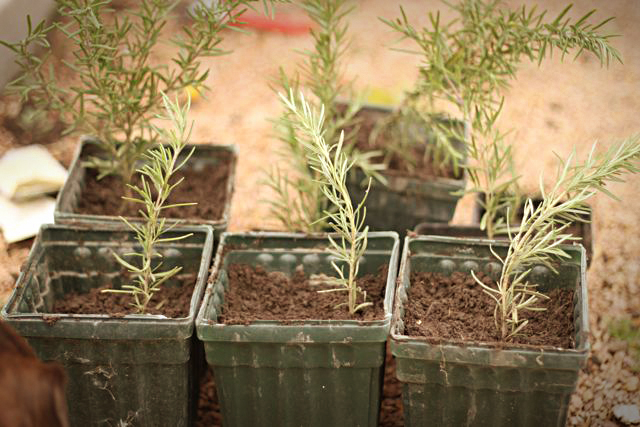
Baby Rosemary. Too lazy to go take picture of bib mamma in the rain...

I live in Minnesota. Global warming (or marketing gimmicks) have pushed the Minneapolis/St. Paul gardening climate into definitive zone 4 and even zone 5 according to some. I, in the hinterlands of Watertown, down in my deep hidey-hole, am a committed zone 3 gardener. It’s just plain colder here. Plus, I hate buying plants that don’t make it through a marginal winter. Some talk about micro-climates. Well, I live in a ass-freezing macro climate of cold. So that’s why I have to take special pains with my rosemary.

Rosemary can take a bit of frost, no problem, but I don’t push it too far. We’ve had two frosts so far, one was a pretty good killing frost for almost everything: beans, pumpkin & squash vines, tomatoes, cucumbers, edamame)

Pumpkin Patch after the killing frost 10.1.09

…The hardiest garden dwellers live on: chard, kale, carrots, parsnips, cilantro, sage, beets, raspberries, even my strawberries still look okay.

brightlights swiss chard 10.6.09 and still kicking.

So, this weekend, I figured it was time to start digging stuff out. First on the list: Rosemary and Lantana. I fear I might be too late with the Lantana, since frost nicked the tops pretty bad in that first frost. When I’m done, I will still need to dig the sage and the thyme. I shouldn’t have to bother with thyme since it’s “hardy” (ha!) Sometimes my thyme makes it through, but it always looks horrible, so I just dig it out to be safe.

For the record. I have a single pane glass greenhouse which is totally useless in the winter, unless you happen to have money dripping off trees and don’t mind 80% of your heating dollars melting away through the glass. I use it as long as I can without heating. When the subzero temps threaten, I drag all these pots of herbs into the dark barn, which doesn’t dip below 32 degrees, but hovers somewhere around 40. I stop watering and basically just leave them alone for a month or two, with the exception of scooping out the inevitable barn-cat poop that appears magically sometime during January.

When the sub zero temps are mostly past, I haul them back into the sunlight, cut them back and begin to water. I’ve been doing this for years with pots of rosemary and sage. You could do it in a basement, too.

One thing that has never worked for me, though, is keeping rosemary in my house. Honestly, I just can’t do it. Sometimes, when my pots burst into flower during February or March, I will bring them into the house to enjoy, but I have seriously almost killed them in just a couple weeks. I have no idea why. Maybe I’m cursed.

Anyway, while digging out the rosemary, I noticed that one of the plants had long, drooping branches that touched the ground. Where they touched the ground, they took root and made it difficult to dig out and put into a pot.

Rosemary Branch Rooted Itself

Being an opportunist, I decided to take advantage of this. It’s the same concept as deliberate layering — a complicated process to propagate plants and some woody shrubs which always eluded me up until now. But here, I’m a better gardener than I thought! (Take that, smug people who can keep rosemary alive in their houses!) I layered my rosemary! Which is really nothing more that pushing a branch down into the dirt and letting it root, then cutting it off the main plant and potting it up.

Nice Healthy Rosemary Roots Ready for Potting

So that’s what I did.

Look at all the new plants!

Now we’ll see if I can remember to water the little pains-in-the-ass.

Filed Under: Garden Tagged With: dig out, Overwinter Rosemary, Propagate rosemary, accidental layering, Lantana, Sage, dormant, greenhouse

Tomatoes! Tomatoes! Tomatoes!

October 3, 2009

(And Vomit-Colored Salsa…)

You really can't appreciate the true vomit color of this salsa.

I know, I know. I’m not winning any fans with my title. But it is vomit colored salsa. What can I say?

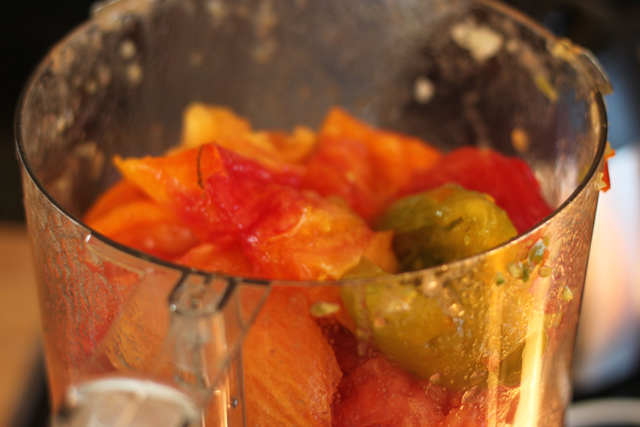
It tastes just as good as red salsa. Mine just happens to be pinkish-orange because of all the beautiful green and yellow heirloom tomatoes that I use. And for whatever reason, I always seem to have the most of the green ones. They are so delicious and sweet, but when you cook them into sauce? Trust me, it’s a tough sell. Everyone will take a jar of my salsa though, vomit colored or not. So there you go.

Heirlooms headed for the salsa pot.

I also made a ton of tomato sauce this year. That always seems to be such a ridiculous waste of fresh garden tomatoes, but really, what else can I do with them? I can only give so many away. I still have a crate full…I’ve dried them before and I just really don’t love dried tomatoes all that much. I’ve rough-chopped and frozen them without cooking for chili, soups, etc. It’s easy and works just fine. You tend to get a lot of liquid, but in chili and soup, who cares? I just don’t make that much chili and soup with chunks of tomato. So this year, after making 20 pints of salsa, I made and froze sauce with the remaining tomatoes.

I’ll tell you how to do both.

For Sauce:
For all the tomatoes destined for the sauce pot: cut all the blemishes off and core. Quarter and put into a pot with a tablespoon or two of kosher salt.. Simmer and mash and stir for a couple hours until about an inch of the watery liquid has evaporated off in steam. Either pulse in food processor (tedious) or use an immersion blender in the pot to puree. Then run through a food mill or sieve. Let cool. I use quart-sized freezer bags and put 2 cups into each one. Lay flat on a cookie sheet and freeze.

For Salsa:
This makes about 20 pints.

20 cups tomatoes
8 cups chopped onion
2 chopped green peppers (variable)
10 chopped small to medium hot peppers (variable)
1/3 cup sugar (variable)
4T chili powder (variable)
4T salt (variable)
2.5 cups white vinegar
1/3 cup cornstarch mixed with equal amount of cold water (variable)

Cut of any blemishes, core and roughly peel the tomatoes with a knife. You can do the dip-into-boiling-water-method if you want, but I don’t bother. Ripe garden tomatoes peel pretty easily without that time consuming step. I’ve also skipped peeling them entirely. Salsa was fine, if you don’t mind little strips of skin here and there.

Cored and roughly peeled tomatoes

Pulse these in the food processor to the consistency you like. Remember that they will soften further when you cook them. My kids hate chunks. My husband loves chunks. So I don’t worry about it too much since no one is ever happy anyway. I forget what’s next…

Pulse tomatoes in food processor

OK, I’m back. I had to go get my notes!

Measure the amount of chopped tomatoes as you go and then dump that into a large stock pot. You will need approximately 20 cups of chopped/pureed tomatoes total. I tend to use a little more. More tomatoes won’t hurt the safe canning ratio, because they are acidic. More onions, peppers and cilantro will. Just so you know. You can play around with the recipe — I always do, mostly because I my pepper variety changes year to year — but keep that in mind. If in doubt, add more vinegar at the end.

Garden Salsa and Thai hot peppers

Chop/pulse a combination of sweet and hot peppers. My mix (above) used about 10 medium sized hot, 4 small and 2 very small sweet green peppers. We like it hot, so I use mostly hot peppers. I take the seeds out of the really hot ones (hungarian yellow, habanero) but leave the rest in. You can do it however you want, just know that the seeds make it a lot hotter.

Add to the peppers  6-10 cloves of peeled garlic. Chop/pulse to desired size and consistency, then add to the stock pot.

Chop/pulse about 3-4 big large onions (enough for 8 cups. you can add less, but not more), add to the stock pot.

Add 2.5 cups of white vinegar. Salt to taste (I used 4 Tablespoons. We like salt.). Grind some pepper to taste. Add 2-4 Tablespoons chili powder. Again, this is personal taste. Start at 2T, taste and add more if you like. I used 4T and it’s tastes highly seasoned. I find that as the jars sit for a while, both the hotness of the peppers and the zip of the seasonings diminish, so I tend not to fear a little overseasoning.

Cook to meld flavors (and kill any lurking bacteria!)

Bring to a simmer and add 1/4 to 1 cup of sugar. Again, personal taste. You can skip the sugar entirely, but I’ve gotta say, if you add just a bit (I use 1/3 cup) people go crazy and don’t know why. Mix 1/3 cup cornstarch* with 1/3 cup cold water and slowly add to salsa pot, stirring often. Simmer for about 30 minutes. In the meantime, sterilize your jars and lids. Right before filling jars, stir in 1/2 to 1 cup of cilantro. Mmmmm. mmmmmm. mmmm. (You either love it or hate it.)

Lots of cilantro. Don't add until right before canning!

Fill hot jars with hot salsa to 1/2″ from the top. Wipe rims and seal. Process in a hot water bath for 15 minutes.

OK, I’m going to be honest here. The woman who started me on her version of this recipe doesn’t process her jars. She says, as long as they “pop” and “seal” as they cool, it’s fine. Her mom has been doing this for years and years and years…Sooo. Neither do I!! But I can’t condone this sort of behavior from anyone else because the USDA says it’s not safe. You know the USDA, right? The harbingers of truth and wisdom? If it weren’t for the cilantro, I’d process away, but the more you cook cilantro, the less flavor it has, so I just have such a hard time putting those jars with beautiful cilantro in the water bath! It probably wouldn’t matter since, by the time the sauce goes into the jars, the cilantro is cooked anyway… Can you tell I’m having an attack of conscience? Well, no one has died yet. If someone does, I promise to update this post.

Anyway, make sure all the lids seal tight (you can test by lifting the jar by only the lid, not the band. It should stay sealed) Immediately reprocess or refrigerate those that don’t seal.

*Cornstarch is a secret and optional ingredient but recommended for salsa that just barely “sticks to your chip” without being thick and overly cooked. I learned the cornstarch tip from Kristi Kratch and can’t thank her enough from saving me from the watery, insipid salsa I had been making up until then. She adds a lot more to hers (1.5 cups). You can too if you want. She also gets credit for the sugar. She uses way more than me (1.25 cups) and I love her salsa, but Dave made me cut back to where I’m at today (1/3 cup). So play with it. Just keep the ratio of acid (tomatoes and vinegar) to non-acid (peppers, onions, garlic, cilantro).

Also, and this should go without saying, don’t eat ANY jars that have lost their seal or are bulging.

And don’t come crying to me if you kill someone with your kindness. It’s a chance you have to be willing to take.

Filed Under: Food Tagged With: tomato sauce, USDA, kill them with kindness, tomato, tomatoes, freezing, heirloom, pink grapefruit, hot salsa, vomit salsa, gross!

ONIONS!

October 1, 2009

Ok, I know most gardeners have long since dealt with their onions, since most are ready to harvest in June. In Minnesota, most of us didn’t harvest until July because of the weather. I pulled all mine out in early August, let them air dry outside for a day or two, then put them in our lower garage, which serves as my pseudo root cellar. I have to say, though, August and September don’t really do much for storing root crops. Flipping back through the notebook I keep in my office with all my to-do’s I see that I started writing “Chop Onions” as early as September 2nd. You will be happy to hear that I was finally able to check that off my list… On September 30th.

I would like to share how I deal with my onions.

Harvested and Cured Onions Ready for Storage and Chopping

Maybe it’s just me, but my onions do not keep through the winter. I don’t know if it’s because I am a bad gardener or because I’m a bad store-er. I’m guessing it’s a little of both. Should I cut the tops off before I cure them, or leave them on? Should I let them dry in the sun a day before shuttling them off to the dark depths of the lower garage or let them dry longer? You can find support for just about any variation. Seriously. I’ve researched this. I’m willing to chalk my failures up to variations in circumstances. That rationale has served me well in all areas of life, by the way.

This year was a good onion year, albeit a late one. After harvesting, I leave the tops on, letting them dry for a day in the sun. Then, I put them in a ventilated box (mine is the lid to an old rabbit hutch, the occupants of which I decided would be happier if left to roam the wilds of our 40 acres) and put them in the lower garage, which is dark and cool.

I write “chop onions” on my to do list about a month later. After ignoring that line item for about a month, I decide to “chop onions” on the day that I also have to “make salsa.” It would be easy to continue to ignore “chop onions” except for the fact that I need a lot of chopped onions to “make salsa.” So, the two would seem to go together quite nicely. (“Make Salsa” post coming in the next day or two.)

In the past, I have been totally anal about the chopping of my onions, preferring perfectly diced cubes, which of course requires hand chopping. This year, however, I have decided to cut corners and pulse the onions in the food processor to see if it makes any difference.

First, however, I have to decide which onions to chop and which to store. Since this was a good year for onions, it appears that I have lots I might be able to store for at least a few months. It would be a lot easier just to store them all, but I have to say: grabbing a handful of chopped and frozen onions during the winter for sauteing is a luxury I have learned not to live without. Plus, when I first started growing onions, I learned the hard way that many of the onions start to rot from the center out. That resulted in a lot of wasted onions for me. Now, I am ruthless when it comes to judging whether an onion should be stored or chopped.

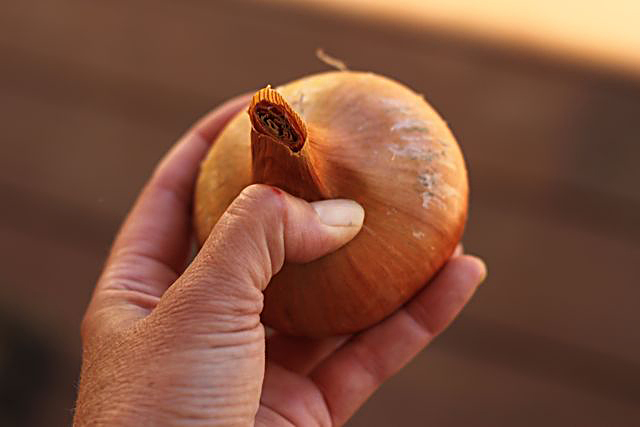
If there is any give at all in the stem area of the onion, it goes into the chopping pile:

Checking Stem End of Onion for Softness. This one is soft.

Sometimes I am right in my assessment:

HA! I was RIGHT! This onion would have rotted within a few weeks.

Sometimes I am wrong:

Oops. This onion would have been just fine to store. Oh Well.

But this year, I am very happy with my storage pile. It’s always nice to have some back-up onions ready for chopping:

Nice Hard Onions Ready for Dark Storage

The rest, I peel and quarter and chop.

Onions ready for chopping.

But either way, let me give you a great tip: USE GOOGLES FOR NO TEAR ONION HANDLING!

Onion Googles! I can't believe I am posting this...

Cute, huh?

I actually saw some onion goggles at a kitchen store in Colorado during our Road Warrior trip. They were $24 dollars! Insane, when you can wear these charming specks designed by Speedo.

Anyway, I put the the chopped onions on to cookies sheets in a layer about 1/2″ to 1″ thick. And let me give you another valuable tip: USE WAX PAPER AS A SHEET LINER. I did not, and now I have onion smelling cookie sheets. Morgan made some cookies yesterday that have a very peculiar onion aroma that I can’t say added much to the flavor of the cookies.

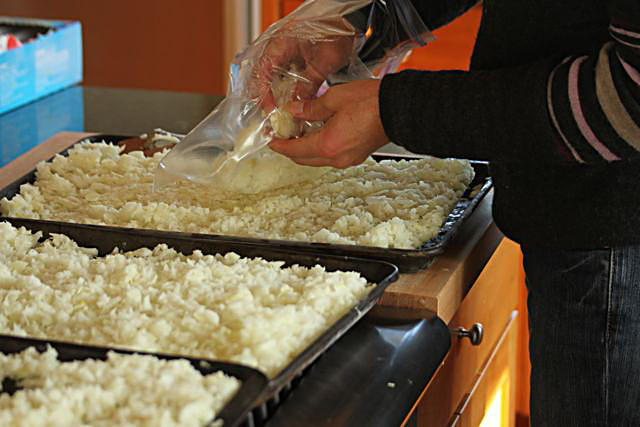
Chopped and Frozen Onions Ready for Freezer Bags.

I freeze the sheets, and then break into pieces and store in freezer bags.

Break up clumps and store.

Once you try this, you will find yourself growing more and more onions. It is an unbelievable time saver.A winter's worth of chopped and frozen onions!

Filed Under: Garden, Food Tagged With: food processor, onions, harvest, freezing, storing, hand chop, rotting, soft, double onion

Primary Sidebar

Read in CHRONOLOGICAL ORDER!

  • Big Bend National Park (6)
  • Alaska Road Warriors (46)

Search jenmenke.com

About Me

Jen menke

I’m a mostly-retired, pretend graphics and web developer (but don’t judge my skillz by THIS site!). We sold our dream home in Watertown, MN and downsized to a “Villa” in Excelsior, MN and built a home in our dream location of Eagle, CO and now split our time between the two states. It is truly a dichotomous life of absentee gardening and getting together with friends & family while in MN and playing hard and hermitting while in CO. I’ve let the blog go but a trip to Alaska has me resurrecting the Road Warriors series. My beloved brother is my biggest fan and I am doing this just for him.

Latest Reads:

Jennie's bookshelf: read

Trail of Broken Wings
2 of 5 stars
Trail of Broken Wings
by Sejal Badani
Started out strong and dwindled off for me. I wasn't enamored of the writing and -- maybe it's just me -- but the secrets!? I understand that you have to be willing to swallow a fair amount of incredulity when enjoying a lot of fiction, ...
The Girl on the Train
3 of 5 stars
The Girl on the Train
by Paula Hawkins
Audible book. Good, mindless listen. Pretty good action and twists. Not as good as all the hype, in my opinion, but I did enjoy. --Not enough to choose for my bookclub though: it would have been carved up by those English-teaching wolves...
I'm a Stranger Here Myself: Notes on Returning to America after Twenty Years Away
4 of 5 stars
I'm a Stranger Here Myself: Notes on Returning to America after Twenty Years Away
by Bill Bryson
Not my favorite Bryson book. However, it's been several years since I last read one and I was -- once again -- astounded by his writing style and voice. I just love him. I think this book is mostly compiled from columns he wrote over a c...

goodreads.com
  • Road Warriors
  • Garden
  • Food
  • Babble
  • Home

Copyright © 2026