• Skip to main content
  • Skip to primary sidebar

Jenmenke

Road Warrior

  • Road Warriors
  • Garden
  • Food
  • Babble
  • Home

Garden

The Earliest Ripe Tomatoes

June 11, 2010

Step-By-Step Instructions

You can read all about Wall-O-Water mini greenhouses, early tomato varieties, special fertilization methods and countless other ways to get the jump on your garden tomato season and try to implement them with varying degrees of success depending on the weather and rainfall in your area. Or, you can follow my easy, step-by-step instructions for the earliest garden tomatoes right here. It’s your choice.

This is the easiest, fastest (by about 2 months!), and foolproof method. It’s a little like scoring a deal on a cute pair of shoes from Target: you might not want to tell anyone how you did it, but you’ll feel a little guilty if you don’t. That’s my disclosure.

Are  you ready?

1) Buy a medium to large tomato plant from a nursery with tomatoes already growing on the plant. Frankly, I don’t think these plants transplant very well, nor do I think they thrive in the garden as well as smaller plants, but don’t worry, because that won’t matter. I bought my beautiful plant in an 8″ pot for only $6.95.

2) Protect your plant from the elements and very gradually harden it off to sunlight and wind. This is important! You don’t want your plant to be stressed when you plant it outside! Most nursery tomato plants have been grown under glass or plastic. Moving them outside into direct sunlight (and even a little wind) can stunt the plant’s growth.

3) Once your plant is hardened off, place it in a protected area of your garden until you are ready to plant it with the rest of your tomato plants.

4) On planting day — this is important — forget to plant your large and pampered tomato plant. In order to get the most ripe tomatoes in the fastest amount of time, also forget to water the plant for approximately 4 days. It is helpful if these four days are also hot and sunny.

5) Wait 7 days.


6) Harvest red ripe tomatoes and brag to neighbors and friends.*

*Disclaimer: This article neither defends nor denies the use of artificial growing methods. Due to challenged diameters, tomatoes are a potential choking hazard for children under 6. Tomatoes are part of the nightshade family; vines are toxic to humans and animals. Methodology is not intended to be a long-term growing strategy nor does it survive cost benefit analysis.

Filed Under: Garden Tagged With: tomatoes, how to, earliest tomatoes

The Trouble with Blue Fescue

June 8, 2010

I Hate To Say “I Told You So,”

So I’ll say “I told him so.”

(Yes, I mean Dave.)

Two summers ago, when we did some new plantings around the house (after 13 years of living here), Dave was set on Blue Fescue in a large area back by the pool. Having dabbled in ornamental grasses for several years, I was dead set against it.

“No Blue Fescue.”

He (and the landscaper) wanted to know what my grudge was against the cute little grass, all spikey and feathery, depending on the time of year.

“Because it isn’t hardy here.”

Au contrair, said they.

“OK, well, even if it says ‘hardy to zone 4,’ I’ve grown it and it doesn’t thrive here. Even if it makes it through winter, it looks like shit.”

“Jennie, don’t swear.”

“Sorry. I just don’t like Blue Fescue, OK? Pick another plant.”

…back and forth and back and forth it went. Dave won. I lost. And we planted about 50 of the suckers.

Then we had a particularly rough winter. The nursery guaranteed the plants and we replaced over half of them. The … (I want you to know that Dave just walked by, looked over my shoulder, read the only sentence that he could see and said, “they don’t look like shit.” and we started the Blue Fescue argument all over again! He’s gone now, so I resume my diatribe.)

The following winter (this past winter) was one of the most gentle that we have ever had, due to the early, insulating layer of snow we had that lasted for the entire season. I had plants alive after the snow melted this year. That has never happened! And yet… this is how the Blue Fescue fared:

It is what I look out at everyday when I’m sitting on the can and it drives me absolutely batty. I’m sure that if it weren’t the view I contemplated for minutes at a time everyday, it would not bug me nearly as much, but there you have it.

It’s a beautiful plant when it thrives. This is it before it flowers

All spikey and blue-grey. Then it sends up its feathery seed heads and it takes on a completely different look of chartreuse green.

Which is of course much different than it’s normal, more subdued state in our yard:

Charming, no?

No.

It’s frustrating because Blue Fescue — this is Elijah Blue blue fescue — is supposed to be hardy to zone 4a. And maybe it is, who knows. I’ve always considered my garden to straddle the line between zones 3 and 4. But everything should have made it through last winter. I’d love to hear from others familiar with this plant. Maybe ‘Elijah Blue’ just hates ‘Jennie With The Pool.’

I’ll be having the Blue Fescue argument for many years to come, I suspect, because there isn’t another low-growing, petite ornamental grass that is hardy here. If it were up to me, I’d put the whole area into a five-foot high wave of miscanthus. (That’s the deeper green grass planted behind the fescue in one of the pictures above.) I love that grass, not just because it is beautiful when in bloom:

But because it is bulletproof.

And I love bulletproof plants. I’ll keep working on Dave. He may have won the round, but not the fight. And I never give up.

Filed Under: Garden, Home Tagged With: miscanthus, hardiness, blue fescue, ornamental grasses

Strawberries and Cream

June 4, 2010

Well, not cream. Half and half.

Dave went to Costco again the other day. He brought home these.

For those of you following along, I am not allowed to complain if he is doing the shopping. However, please note that if Dave were to take notice of his surroundings, he might have seen this in the garden:

Of course, to be fair, it surprised me, too. The mosquitos are HORRENDOUS and you simply can’t go out there for more than a quick jog-through to the compost or doing a lively dance while scrambling to grab some cilantro and running while swatting your hands all around. (You can picture it, right?) You can, of course, douse yourself with bug spray, which I do when I am going out there for any length of time — which I did yesterday to clear the melon/squash/pumpkin patch of weeds:

Before
During
After

An amazing transformation, wouldn’t you say? (Off topic, I know…)

So anyway, I guess we have to give Dave a pass for buying the strawberries. That uses up his pass for the week, just so you know. Obviously I am eating the garden strawberries. Any ideas for the store-bought strawberries? And please don’t say jelly!

…maybe a granita for our Meatless Monday walleye meal tonight? Or, I know! A blind taste test! I’ll do it tonight and append this post tomorrow. Stay tuned!

Filed Under: Garden Tagged With: Strawberries, weeding

Planting the Tomatoes

May 29, 2010

With the Help of Heavy-Duty Concrete Reinforcing Wire.

I finally bought my tomato and pepper plants. I should really buy them sooner. Actually, I should start them from seed in March. Better yet, I should save my seed from the previous year, thereby keeping only the best…

You see? You see the black hole of my thoughts?

How can I ever be happy and satisfied when I am constantly being shoulded-upon?

Back to the tomatoes.

They are itty-bitty little things, but that’s OK, they’ll catch up. I have learned over the years, that even when I buy a large tomato and plant it with itty bitty tomato plants, the small ones tend to catch up. The big ones might even have tomatoes on them and yet they only produce red tomatoes maybe a week sooner. In fact, I think transplanting the larger tomatoes stresses them and sets them back. Otherwise it just doesn’t make sense.

I even bought a large 2′ tomato plant this year to test it and really watch it so I could do a controlled experiment and chronicle it here. An Early Girl hybrid, since all the rest of my plants were to be heirlooms.

Well, forget about that plan. Because I forgot about that plant. Forgot to water it. And now it’s dead. Too bad I forgot to take a picture, because once I got over being mad, it was pretty funny.

Aside from doing nothing and letting the vines sprawl on the ground, there are two main ways to grow tomatoes. Staking and caging. There are pros and cons to each.

Pros of Staking: If driven deep into the ground, staked plants won’t blow over like caged plants can. Many say staked plants produce larger fruit because plant energy is concentrated on the tomatoes and not on excess foliage . There is less disease due to more air circulation (though that didn’t seem to help me all that much). Staked plants take up less room.
Cons of Staking:  Staked plants have less foliage which can reduce the sweetness of the tomato and can promote sun-scald in high heat/sun areas. Pruning takes commitment. (Basically, what that means is, if you plan to go out of town for more than a day or two, forget it. You will come home to chaos. In your frantic effort to get the plants back to one stem, you will need to “pinch off” a 1″ diameter sucker. You will inadvertently pinch off the central leader and doom your tomato plant to a stunted existence. And your hands will always smell like tomato plants.)

I used to always stake, because that’s how my mom did it. Simple as that.

I even tried the staking method that has you wind the stems around strings run vertically. It was an interesting season. It ended in disaster when the whole rig came crashing down from the top. I suppose that’s another downside of staking. IF something happens to the main stem, it’s a goner.

I was never good at staking.

Now I cage.

But caging hasn’t been without its own set of problems. Aside from strong winds that have blown my cages over, I’ve been through many iterations of the cage. The ones you buy at the store are, what? Two or three feet high? Even in Minnesota with a short growing season, most plants grow to twice that size. Honestly, there ought to be a law against 3′ tomato cages… In order to find a cage that was actually tall enough to support the plants, I was forced to make my own, which then made staking seem like a better idea again…

But no, I persevered.  I bought wire and made the cages. I only forgot one small detail: you have to be able to get your hand through the wire to pick the tomatoes.

Not to worry. I used wire cutters and cut larger holes here and there. The bummer was, the holes never seemed to be in the right place, and when I stuck my hand through, I inevitably cut my hand on the sharp wire.

They were the worst tomato cages ever! [Maybe even as bad as the ones the stores sell.]

Tomato cage adaptation number three was the one I had been trying to avoid: concrete reinforcing wire. You buy it in rolls that weigh about 200 pounds. I’m not kidding. It wasn’t something I could do by myself. Since I am not a team player, and I don’t like to ask for help, I had avoided it for several years. But it was clear: if I didn’t want to stake my plants, and if I didn’t want to be making tomato cages every damn year, then I was going to have to ask Dave for help gettin’ me a load of concrete reinforcing wire home from Home Depot. [Why doesn’t someone go into business selling these?]

It was a big job, and since doing it more than 6 years ago, I’ve never had to make another tomato cage again. They really are worth the effort. They are heavy, don’t blow over and have nice, large holes for your hands. They patina (rust) as they age and fit right in aesthetically… I’ve even grown pole beans and other climbing things on them. They are the best tomato cages ever! But caging also has its pros and cons.

Pros of Caging: Easy; not much maintenance. Supports the plants. Bushier growth and more greens-to-red ratio promotes sweeter tomatoes, or so they say.
Cons of Caging: Sometimes a weaker plant doesn’t grow bushy enough to truly be supported by the cage. Smaller fruits. Cages takes up more room per plant. Plants are more prone to disease if growth is dense and shady

Still, I’m a cager. This year, though, I’m trying something new: I’m planting the tomato at the base of a stake inside the cage so that should the plant need additional support, there will be something there to tie it to.

Genius, I know.

I also usually prune the early suckers (growth at occurs at the “v” between the stem and lateral branch) until they get away from me.

Back to the act of planting of my tomatoes.

FIRST, I had to decide where to put the tomato plants: inside the garden proper or outside it, where they were last year when I moved them out by the squash and pumpkins because I had had two bad tomato years in a row with early blight.

What’s early blight?

Early blight is some lame generic term for: your-tomatoes-are-dying-from-the-ground-up-earlier-than-they-should-be-and-who-knows-why.

You know, the leaves turn spotty yellow then spotty brownish black. Then the stem falls off. Then the spotties hop from one branch to the next until all you have is a vertical plant with about 5 leaves at the very top and 10 tomatoes on it. The fruits will still ripen, but they don’t taste as good because it’s the healthy greens that give the tomato its sweetness. I hate early blight. It’s like having a glaring failure for all the world to see when they walk through your garden…

So I moved them out by the squash and melons hoping to get away from what I figured was contaminated dirt inside my garden. The blight was less pronounced out there. Maybe that’s because they were watered exclusively with a soaker hose. (Tomatoes don’t like to be watered from the top. Tell that to the Creator who deemed otherwise). It was a hard decision and one that I had given a lot of thought to. I was still on the fence until I went out there with the plants and compared the current state of my planting site choices:

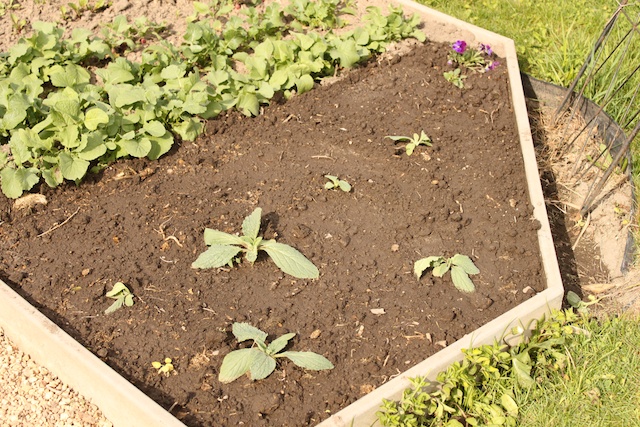
Hmmm. Tough choice. Let’s see. I can spend the next 4 hours weeding the patch outside the garden…. Or I can spend 5 minutes weeding the box inside the garden. Hmmmmm.

So the tomatoes are inside the garden this year. We’ll see how it goes.

And just so you know. I actually pulled out some borage seedling volunteers that were all around the chives. I didn’t move them to another spot (I was short on time). I didn’t leave them there to enjoy. I ruthlessly pulled them out.

And I still feel bad out it.

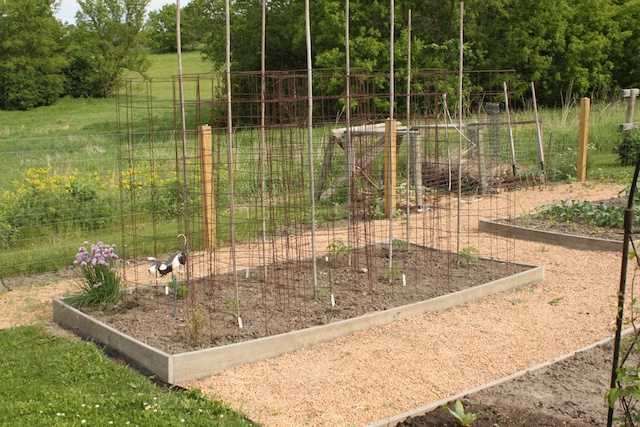
So this is how it looks all finished:

and a little closer:

…and should you ever require nice unobtrusive stakes for you pepper plants (because mine always break in a storm), consider another concrete reinforcing product: rods!

I think they look almost arty.

Filed Under: Garden, Babble Tagged With: staking, caging, pros and cons, early tomato blight, tomato, pruning, planting tomatoes

Your Daily Lesson: Mint is Invasive

May 25, 2010

…Lest there is anyone else as gullible as I.

We are surrounded by things that should illegal: Motorcycles without mufflers, Barbie commercials that make them look like they can walk by themselves, food labeling that want you to believe a fruit snack is as good for you as the real thing, and

…plant descriptions that say, New! Clumping, non-invasive spearmint.

Wow, thought I. Non-invasive mint! Buy, buy, buy, buy. (That means I bought four of them). So excited! Plant, plant, plant, plant. And now…

Dig, dig, dig, dig.

Every. Single. Year.

I will never be rid of that mint.

You gotta admire the tenacity. It’s in the same league as my admiration for raccoons. I can’t deny they should be complimented on their tenacity. I’ve got an idea for a new breed of raccoon: hybridize them to eat mint and not chickens.

Anyway. Please, if you learn anything today, learn this:

  1. What you order at McDonalds will not look like it does on TV, and
  2. All mint is invasive, no matter what the label says.

In other gardening news:

Itty bitty apples have formed. While I can’t see the whole tree, it appears that I will have at least some apples, despite the frost. Yee ha. That means more apple jelly this fall!

Volunteer borage and sunflowers have been relocated to their rightful homes

For those of you with keen eyes, yes, this is the bed I just dug the mint out of, pictured above. Gardening for me is often this way. I go out to do something specific and find I have to complete three other tasks before I do the one thing I intended. In the case of the borage, I went out to plant the corn. But found I couldn’t plant the corn because in the bed I planned to plant it, were several borage and sunflower seedling volunteers from last year that needed to be moved.

You see, rather than start seeds or buy new plants, I just move around the ones that self sow and come up on their own. And this year, instead of putting the borage in with the herbs like I usually do:

(which always gets to be too crowed and chaotic, but you can see a borage volunteer right up against the chives, which I should have pulled but didn’t have the heart to. Oh dear…), I decided to put them in the center area where I usually have zinnias. I do love zinnias. I’m going to miss them this year. But:

  1. I didn’t start zinnia seeds yet
  2. I’m sick of buying them and don’t plan to go back to the garden store, and
  3. They always look crappy by the end of the summer. I don’t know why. Maybe I don’t deadhead them enough?

They will be replaced with the borage which

  1. Looks FABULOUS in a vase with sunflowers
  2. The bees LOVE
  3. Are nice enough to start themselves from seed for FREE

You can also eat borage and though I mean to look into this each year, I have never gotten around to it.

So anyway, I needed to move the borage OUT of the corn bed and IN to the spot planned for them. BUT I couldn’t do that because…

The MINT needed to be dug out first.

You getting all of this?

You starting to understand why I can’t get Jeanette’s brochure done for her?

Anyone want to call Jeanette for me and let her know all of this? If so, I would really appreciate it. Because I’m too embarrassed to call her.

So that’s it. I plan to go pick up my tomatoes, peppers and eggplants up today. I’m getting them from a FABIE local heirloom, organic grower. Total granola guy. He’s gonna change the world. Which is great, but all I really care about at this point are his plants. Which, if they are like last year’s, are stocky little healthy workhorses. Already hardened off. Amazing. It’s called Knightshade Gardens. If you live near me in Minnesota, you can reach them at 952-564-1714. They sell out in the western suburbs around Maple Plain.

Then, all I’ll have to do is plunk the tomatoes into the ground in their intended spot tomorrow:

GAK!

Filed Under: Garden Tagged With: invasive mint, volunteer plants, borage, sunflowers, Knightshade Gardens, weeds, Apples, self sow

What a Difference a Day Makes

May 24, 2010

In Minnesota, anything is possible. Anything with the weather, that is. On Saturday, I laid in bed, reading, working on my computer, happy. The weather map showed a great big sunshine with a high of 83. Not sure why that was, because out my window it was windy, cold, and 48 degrees. And then, in true Minnesota fashion, by Sunday it was humid and 90.

While much of the time I tend to be unmotivated and lazy, I go through periods of high activity. I call it my Busy Beaver mode. I do all kinds of things that have been nagging away at me. Like my ironing.

Kidding. I never do my ironing.

I’m talking about stuff like re-caulking, stripping my kitchen table, grinding the edge of a paver that heaved over the winter. Fixing my stove. Stuff like that.

So I’ve been in Busy Beaver mode for almost a week now. And let me tell you: these things are really better left undone. Laziness has it virtues. Consider this:

  1. The caulk I spent 2 hours applying and perfecting, apparently is bad or expired. Apparently this happens (google “silicone won’t dry” and see for yourself). You have to take it all off and re-do it with new caulk. Shoot me now, because that sounds more pleasant than re-caulking.
  2. I began stripping the kitchen table on a cold and windy Saturday. I applied the first coat of polyurethane on Sunday — when it was 88 degrees and about 75% humidity. Needless to say, it is still wet.
  3. The three hours I spent taking apart my gas cooktop, in order to *finally* figure out why the back burner wasn’t working resulted first in triumph: “I think I finally know what’s wrong with it!!” And was quickly followed by despair: “The part you are looking for has been discontinued by the manufacturer and cannot be replaced.” Calls to obsolete parts stores and online searching resulted in a big fat nuthin’.

Shouldn’t we feel rewarded for our efforts? It seems as though I’m being punished.

Getting to the point of my post: because of these tasks, I neglected to go out to the garden for one day. One stinkin’ day. I last picked the asparagus on Saturday afternoon, mind you. It had been left on its own for 36 hours. This is what I was presented with this morning:

Eee gads. At this point I think, “Oh the Hell with it, I’m just gonna let go to seed. I’m sick of it anyway.” But then the other side of my very active brain says, “But Sharon and the rest of the family will be counting on boatloads of asparagus over Memorial Day weekend…”

And so I set about crushing beetles and picking the good spears. Much of it I left to go to seed. It’ll happen over the weekend while we are gone anyway, I would guess.

In other gardening news, I feel like a farmer when I say this, but: I got my beans and corn in!

I still have to get the cucumbers, tomatoes, peppers, eggplant, squash, melons and zucchini planted. That seems like a long list… It IS a long list, though I do tend to wait until after Memorial day to plant the tomatoes, peppers and eggplant plants (Remember: anything can happen in Minnesota with regard to the weather). I know what you are thinking, and yes, the seeds should have been in the ground a week or two ago I can’t help it. I’ve been busy. It’ll be fine.

Then, I just have to remember to update my garden notebook with where everything is planted so I remember for next year. It’s funny how if I don’t do it right away when I’m first planting the garden, it just never gets done.

I always mean to note planting dates, first harvest dates, notes about growing conditions, pests, etc. I’ve been keeping the notebook since 1998. It’s been 12 years. I’m still working on it. In fact, I’m gonna go get it right now and update it. Hopefully, I won’t get distracted by something on my way…

Filed Under: Garden, Home Tagged With: asparagus, minnesota weather, busy beaver, planting the garden

  • « Go to Previous Page
  • Page 1
  • Interim pages omitted …
  • Page 5
  • Page 6
  • Page 7
  • Page 8
  • Page 9
  • Interim pages omitted …
  • Page 14
  • Go to Next Page »

Primary Sidebar

Read in CHRONOLOGICAL ORDER!

  • Big Bend National Park (6)
  • Alaska Road Warriors (46)

Search jenmenke.com

About Me

Jen menke

I’m a mostly-retired, pretend graphics and web developer (but don’t judge my skillz by THIS site!). We sold our dream home in Watertown, MN and downsized to a “Villa” in Excelsior, MN and built a home in our dream location of Eagle, CO and now split our time between the two states. It is truly a dichotomous life of absentee gardening and getting together with friends & family while in MN and playing hard and hermitting while in CO. I’ve let the blog go but a trip to Alaska has me resurrecting the Road Warriors series. My beloved brother is my biggest fan and I am doing this just for him.

Latest Reads:

Jennie's bookshelf: read

Trail of Broken Wings
2 of 5 stars
Trail of Broken Wings
by Sejal Badani
Started out strong and dwindled off for me. I wasn't enamored of the writing and -- maybe it's just me -- but the secrets!? I understand that you have to be willing to swallow a fair amount of incredulity when enjoying a lot of fiction, ...
The Girl on the Train
3 of 5 stars
The Girl on the Train
by Paula Hawkins
Audible book. Good, mindless listen. Pretty good action and twists. Not as good as all the hype, in my opinion, but I did enjoy. --Not enough to choose for my bookclub though: it would have been carved up by those English-teaching wolves...
I'm a Stranger Here Myself: Notes on Returning to America after Twenty Years Away
4 of 5 stars
I'm a Stranger Here Myself: Notes on Returning to America after Twenty Years Away
by Bill Bryson
Not my favorite Bryson book. However, it's been several years since I last read one and I was -- once again -- astounded by his writing style and voice. I just love him. I think this book is mostly compiled from columns he wrote over a c...

goodreads.com
  • Road Warriors
  • Garden
  • Food
  • Babble
  • Home

Copyright © 2026